
1099 independent contractor pay stub: what to include

Independent contractors don't receive pay stubs. Clients report what they paid on Form 1099-NEC once a year, and there's no stub per payment. To document income in between, a contractor makes a pay stub for each payment or each month showing the client, the period, the gross amount and any taxes the contractor set aside.
That record is useful well before tax season: when renting, refinancing, applying for a car loan or simply checking whether this year is on track.
Steps at a glance
- Choose the payer. Enter the client who paid you as the company, or your own business if you combine clients.
- Enter yourself as the payee. Add your name, address and a contractor ID if you use one.
- Enter the gross payment. Add the amount received, as hours × rate or a flat project fee.
- Record tax set-asides. List the amounts you moved aside for federal and state estimated taxes.
- Export and match to your records. Save the PDF with the invoice and the bank deposit.
1099 vs W-2: why contractors don't get stubs
A W-2 employer runs payroll: it withholds income tax, Social Security and Medicare, pays its share of payroll tax, and gives you a stub showing all of it. A client paying a contractor does none of that. It pays the invoice in full and, if the total for the year is above the IRS reporting threshold, files a 1099-NEC.
So a contractor's gross and net from the client are the same number. All the tax work, including self-employment tax and estimated payments, sits with you. A pay stub is how you make that visible.
What a contractor pay stub should include
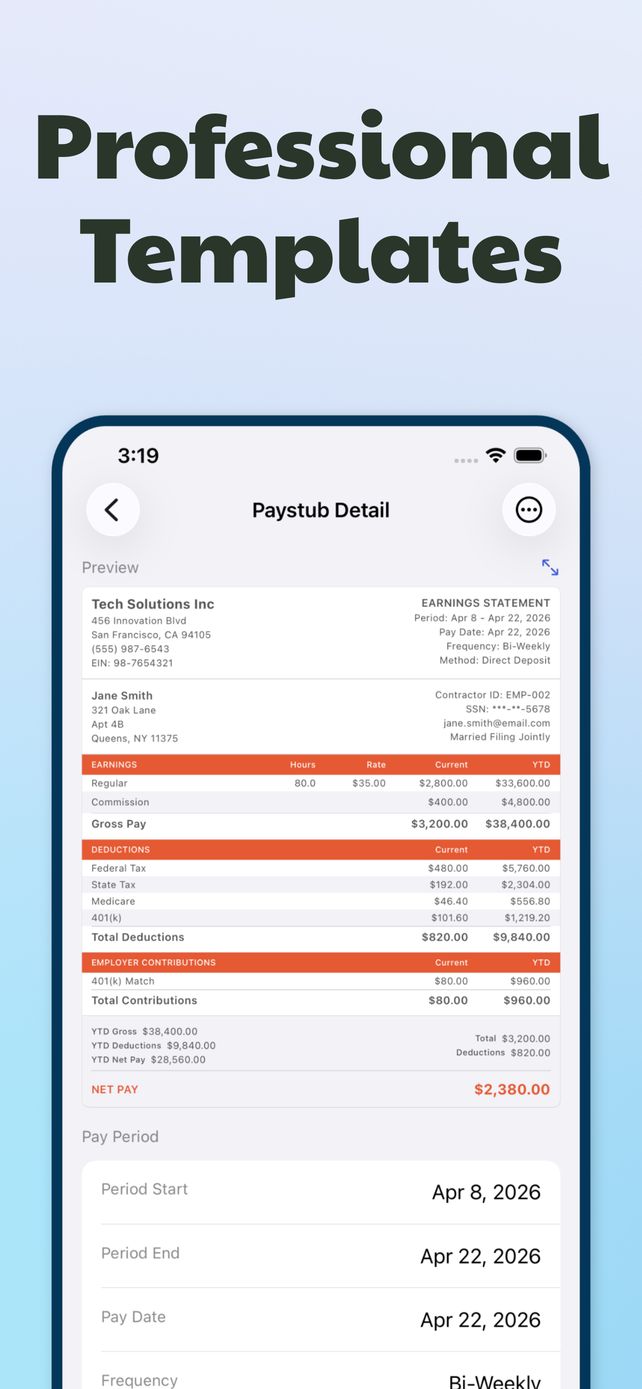
Keep the layout of a standard earnings statement so anyone can read it at a glance:
- Payer: the client's name and address, or your own business if one stub covers several clients
- Payee: your name, address and contractor ID (the app has a field for it)
- Period and pay date, matching the invoice and the deposit
- Earnings: hours × rate or a flat project fee, with separate lines for expenses the client reimbursed
- Deductions: your own set-asides for federal and state estimated tax, clearly named
- YTD totals, so the stub doubles as a running income summary
One stub per client, or one per month?
If you have one or two steady clients, make a stub per client per payment: the client is the payer, and each stub ties to one invoice. That's the most convincing format for a landlord because it looks like ordinary employment.
If you have many small clients, make one stub per month with your own business as the payer and a line per client under earnings. History in the app keeps both kinds searchable by name, and Insights totals net pay by month, quarter or year.
Taxes contractors should show on the stub
Self-employment tax is 15.3% on 92.35% of net earnings, plus federal and state income tax. Since nothing is withheld, set aside a fixed share of every payment, commonly 25% to 30%, and pay quarterly estimates. Listing those set-asides as deductions keeps your stub's net pay honest and gives you a ready record of what you saved.
Don't label set-asides as "Federal withholding" or "Social Security withheld." Nobody withheld them. "Federal estimate (set aside)" is accurate and won't confuse a reviewer.
Keep it consistent with your 1099s
At year end, add up your stubs per client and compare them with each 1099-NEC you receive. They should match, give or take payments that crossed the year boundary. If they don't, find out why before you file. Stubs that agree with 1099s and tax returns are the ones that work as proof of income.
Questions
Is a 1099 form a pay stub?
No. A 1099-NEC is a yearly total sent to you and the IRS. A pay stub covers one payment or period. Many contractors keep both: stubs during the year, the 1099 at the end.
Can a contractor show deductions on a pay stub?
Yes, as long as they're labeled as what they are, such as estimated tax set-asides or retirement contributions you made yourself.
Related guides
 How to make a pay stub if you're self-employedPayer, payee, owner's draw and tax set-asides, done so the numbers hold up.
 Proof of income for self-employed peopleWhich documents landlords and lenders accept, and how pay stubs fit in.
 How to read a pay stubEvery section and abbreviation, walked through on a real example.