
How to make a pay stub if you're self-employed

If you're self-employed, you make your own pay stub by listing your business as the payer and yourself as the payee, entering what you actually paid yourself for the period, and showing what you set aside for taxes. Then you keep it with the bank statement that shows the same transfer.
Nobody hands a freelancer or sole proprietor a pay stub, yet landlords, lenders and even some government programs still ask for one. A self-made stub works when it summarizes real money and agrees with your records. Below is how to build one that holds up.
Steps at a glance
- Pick a pay schedule. Choose weekly, bi-weekly or monthly and stick with it.
- Move the money. Transfer your pay from the business account to your personal account so there is a matching deposit.
- Enter business and personal details. Business as the payer, you as the payee.
- Enter gross pay and set-asides. Gross is the amount you paid yourself; list tax set-asides as deductions.
- Export and file with the bank statement. Save the PDF next to the statement that shows the transfer.
Pay yourself on a schedule first
A pay stub describes a payment, so the payment has to exist. The cleanest setup is a separate business account and a regular transfer to your personal account: every other Friday, or on the 1st of the month. That transfer is your paycheck, and the stub is its paperwork.
If your income swings a lot, pay yourself a steady base amount and leave the rest in the business account as a buffer. A steady stub history reads better to a landlord than wild swings, and it's easier to budget around.
What counts as gross pay when you're self-employed
For a sole proprietor or single-member LLC, gross pay on your stub is the amount you paid yourself for the period, often called an owner's draw. It is not your total revenue. If clients paid $6,000 this month, you spent $900 on software and supplies, and you moved $3,500 to your personal account, the stub shows $3,500.
If your business is an S corporation and you run real payroll, you are an employee of your own company and your payroll provider's stubs are the official ones. This guide is for people without formal payroll.
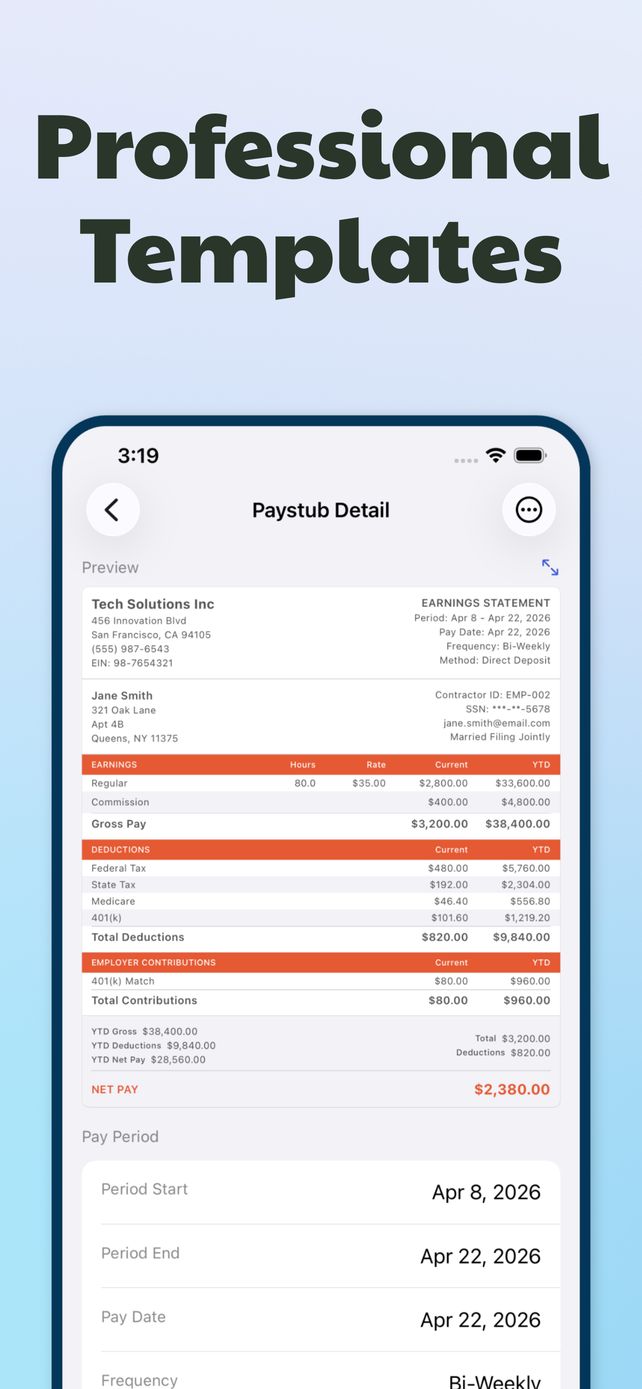
Showing taxes on a self-employed pay stub
No one withholds tax from an owner's draw, but you still owe it. Self-employment tax is 15.3% (12.4% Social Security plus 2.9% Medicare) on 92.35% of your net self-employment earnings, on top of income tax. Most people pay it through quarterly estimated payments due in April, June, September and January.
A practical approach: when you pay yourself, also move a fixed share, often 25% to 30%, into a tax savings account, and list it on the stub as deductions such as "Federal estimate" and "State estimate." Then the stub's net pay matches what actually landed in your spending account, and you have a record of your set-asides when estimated taxes are due.
Build the stub
Enter your business as the company, with your business address and EIN if you have one. Enter yourself as the worker. Set the pay period and frequency to match your transfer schedule, add the gross amount, add your tax set-asides and any other regular deduction such as a SEP-IRA contribution, and check the YTD totals.
Export the PDF and save it in the same folder as that month's bank statement. When someone asks for proof of income, you send both, and they agree with each other.
What a self-made pay stub can't replace
Treat your stub as a summary of the evidence. Mortgage lenders usually want one or two years of tax returns from self-employed borrowers. Landlords often accept stubs but may also ask for bank statements or 1099s. The stub's job is to make your income easy to read; the other documents prove it.
Never enter numbers you didn't pay yourself. A pay stub that overstates income on a lease or loan application is fraud, and it's also easy to catch: the reviewer only has to compare it with your bank statement.
Questions
Can I use my business name as the employer on my own pay stub?
Yes. Use your registered business name or your own name if you operate as a sole proprietor without a separate name. Keep it consistent with your invoices and bank account.
How often should a self-employed person make pay stubs?
Match your pay schedule. If you transfer money to yourself twice a month, make two stubs a month. Regular stubs build the history that landlords and lenders like to see.
Related guides
 Proof of income for self-employed peopleWhich documents landlords and lenders accept, and how pay stubs fit in.
 1099 independent contractor pay stub: what to includeContractors don't get stubs. Make one that matches your 1099s.
 How to make a pay stub on iPhoneFour steps from blank form to a PDF you can email, text or print.