How to read a pay stub

A pay stub reads top to bottom: who paid and who got paid, the pay period, what you earned (gross pay), what was taken out (taxes and deductions), and what you received (net pay). Each line usually has two amounts: this period's figure and the year-to-date (YTD) total since January 1.
Here's each section on a sample bi-weekly stub, plus the abbreviations that confuse people most.
The header: employer, employee and pay period
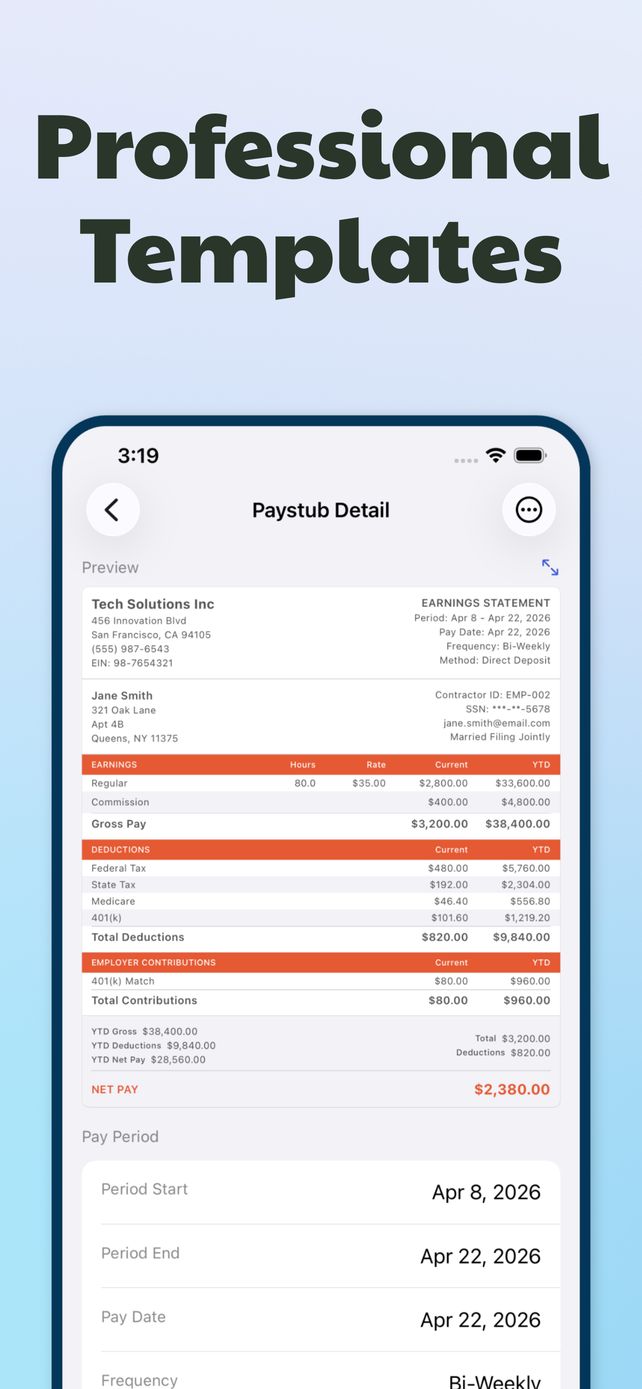
The top block names the employer with its address and EIN, then the employee with address, ID and a masked SSN. Next to it you'll find the pay period dates, the pay date, the frequency (weekly, bi-weekly, semi-monthly, monthly) and the payment method.
Check these first. A wrong period or pay date is the most common reason a landlord or lender rejects a stub.
Earnings: gross pay explained
Earnings lines show how gross pay was built. On the sample, Regular is 80.0 hours × $35.00 = $2,800.00 and Commission adds $400.00, so gross pay is $3,200.00. Other common lines are OT (overtime), Bonus, Holiday, PTO (paid time off) and Reimb (expense reimbursement, which usually isn't taxed).
Deductions and the abbreviations behind them
Deductions are everything subtracted from gross. The usual codes:
- FED, FIT or FWT: federal income tax withheld, based on your W-4
- ST, SIT or SWT: state income tax
- SS, OASDI or FICA-SS: Social Security, 6.2% of wages up to the yearly wage base
- MED or FICA-MED: Medicare, 1.45% of all wages (plus 0.9% above $200,000)
- 401(k), 403(b): retirement contributions; traditional ones are pre-tax for income tax
- Med/Den/Vis: health, dental and vision premiums
- LOC or CITY: local income tax; SDI: state disability insurance in some states
What YTD means and how to check it
YTD is the running total for the calendar year. On the sample, YTD gross is $38,400.00 and YTD deductions are $9,840.00, so YTD net pay is $28,560.00. That's exactly gross minus deductions, which is the first sanity check.
The second check: this stub's YTD should equal the previous stub's YTD plus this period. If the sample's previous YTD gross was $35,200, adding this period's $3,200 gives $38,400. When YTD jumps by more or less than the current amount, ask payroll why.
Employer contributions and net pay
Some stubs have an Employer Contributions section, like the $80.00 401(k) match on the sample. That money is yours but it goes to the retirement account, not your paycheck, so it doesn't change net pay.
Net pay is the bottom line: $3,200.00 − $820.00 = $2,380.00, which should equal the deposit in your bank account. If it doesn't, that's the number to raise first.
Questions
Why is net pay so much lower than gross pay?
Taxes and deductions. Federal and state income tax, Social Security, Medicare and benefit premiums together often take 20% to 30% of gross pay.
What does OASDI mean on a pay stub?
Old-Age, Survivors and Disability Insurance, the official name for Social Security tax. It's 6.2% of wages up to the annual wage base.